New in Facts, Rules, Runtime: How a Harness Learns from Engineering Judgment.Facts, Rules, Runtime: Post 3 is live. Read the post
Angela McNeal - CEO & Co-Founder
February 24, 2026
The conversation around enterprise AI has shifted. Generative AI initially captured attention through chat interfaces and productivity tools, applications that have proven exceptionally valuable for accelerating individual work. The evolution now moves these capabilities from personal workflows into cross-system and team operations, where AI doesn't just suggest and draft but also executes.
This transition demands a fundamental rethinking of how we deploy AI. When an agent writes to databases, authorizes payments, or updates financial systems, workflow failures carry significant business consequences. The architecture required for "chat interface" AI simply cannot support "stateful agent" AI. Production-ready deployment requires something more sophisticated: controlled autonomy.
Controlled autonomy enables AI agents to reason and act independently, but only within explicitly defined trusted boundaries. It's the difference between an assistant that suggests actions and an agent that executes them safely. Without the technical foundation that enables this, the gap between innovative potential and operational readiness remains unbridgeable.
This guide examines the architectural pillars required to deploy AI at enterprise scale: a practical framework for moving from prototype to production.
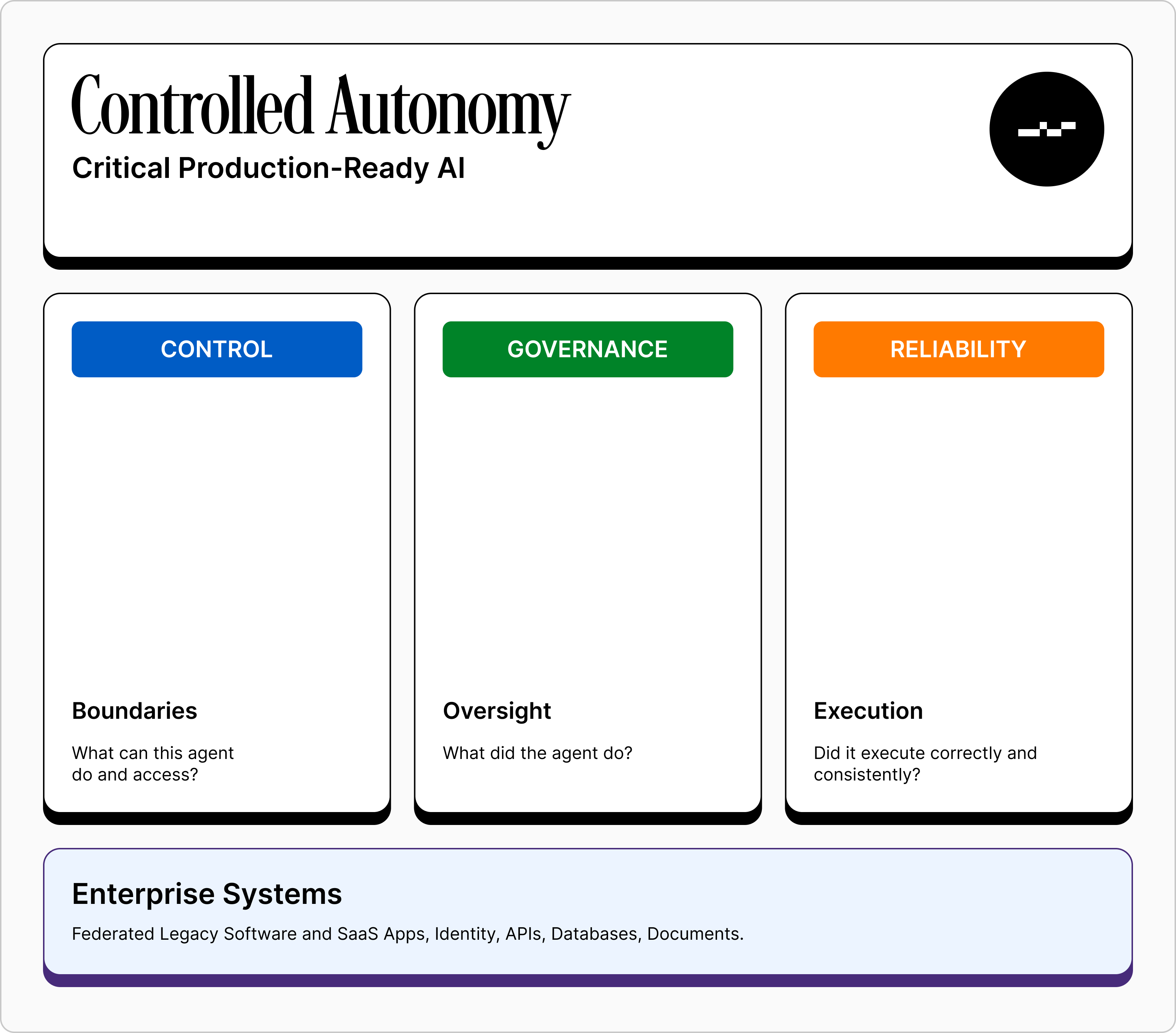
Thread AI Pillars that Enable Controlled Autonomy for Critical Enterprise Operations
The pattern is familiar: pilots succeed in controlled environments, value is demonstrated, but scaling to production reveals architectural gaps. This failure stems from three persistent barriers.
Siloed initiatives create disposable projects. Without a unified platform for component reuse, each AI initiative becomes standalone work. A Sales team agent that extracts prospect data can't be easily reused, or is even visible, by the marketing team's personalized ABM campaign running simultaneously. Federated teams rebuild similar capabilities repeatedly, preventing compounding value.
Infrastructure complexity delays production. Assembling disparate tools, connecting legacy systems, and integrating multiple models creates brittle stacks with high operational overhead. Most internal builds fail not on Day 1, but in week two or the following month. API schemas change upstream, model versions deprecate, and custom glue code breaks. Without a unified control plane, engineering teams spend more time debugging infrastructure than delivering business value.
Absent guardrails erode trust. Critical environments demand visibility, control, and human oversight. When these capabilities are absent, AI decision-making becomes a black box—and the business risk of deployment outweighs its potential value. A manufacturer won't leverage AI to inject a product's Bill of Materials into its ERP system without verifying the creation process and validating the output.
These barriers are architectural. Overcoming them requires purpose-built infrastructure designed for enterprise scale and complexity.
The scope of what can be intelligently automated has expanded far beyond simple tasks. Processes that require synthesizing data across dozens of sources, applying complex regulatory logic, and making decisions with real consequences are now addressable - but only with the right architectural foundation. For example:
Know Your Customer and Anti-Money Laundering processes synthesize data across dozens of sources, apply complex regulatory logic, and make decisions that carry both compliance and reputational risk. Agents must access sensitive data securely while maintaining complete audit trails.
End-to-end automation means AI agents write directly to sensitive financial systems: posting entries, creating reports, updating ledgers. A single error creates accounting discrepancies that cascade through financial reporting. In these environments, 95% accuracy isn’t a success metric; it’s a liability.
Energy infrastructure projects require navigating complex permitting processes across multiple regulatory bodies, tracking evolving compliance requirements, and ensuring documentation meets stringent standards. Agents must coordinate across jurisdictions while maintaining complete regulatory audit trails.
Request for Proposal workflows require access to proprietary information, understanding complex business logic, and generating responses that represent binding commitments. The speed and accuracy of these documents determine won or lost business.
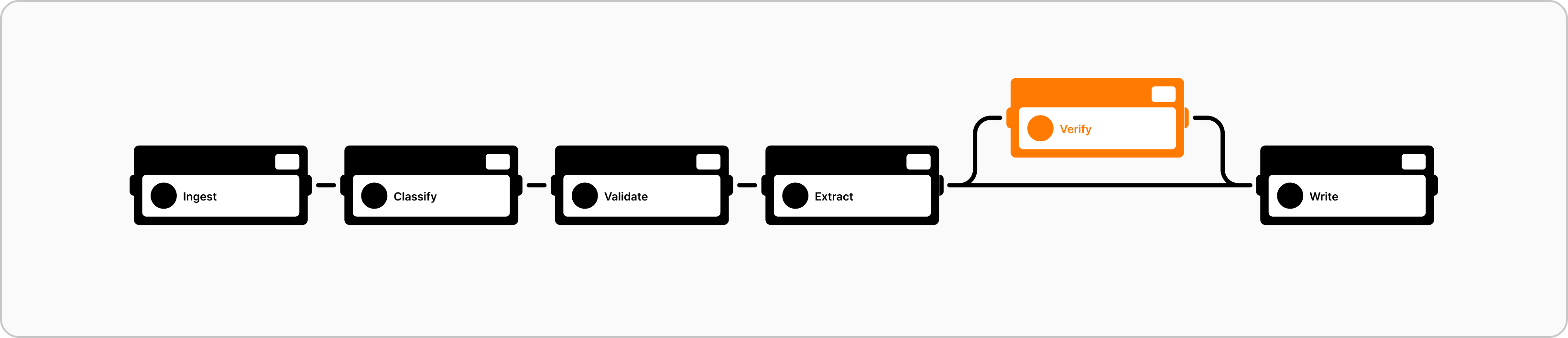
Invoice Processing workflow: From doc ingestion to human review of extracted data and writing to sensitive systems
These represent the core business processes that drive organizations forward—and precisely where controlled autonomy becomes essential.
To address these challenges, Lemma was designed as AI infrastructure and workflow orchestration purpose-built for critical enterprise-scale production. The platform enables safe implementation of governed, reliable AI workflows and agents in cross-system operations that cannot fail; providing the infrastructure for agents to reason, plan, and act within observable guardrails, at scale.
Before examining each architectural pillar, it's important to understand the approach that enables them: composability and elasticity.
Production AI demands integration at the protocol layer, not through brittle abstraction frameworks. Instead of relying on rigid wrappers that break when APIs change, Lemma enables agents to speak the native language of your systems. This allows diverse software to communicate efficiently without the "glue code" that plagues internal builds.
Still, because technologies and requirements evolve constantly, there must be flexibility to swap components without compromising reliability guarantees. Lemma's workflow engine uses dynamic provisioning and event sourcing to ensure durable, fault-tolerant execution of workflows across tenants and parallel tasks. Plus, it natively interacts with REST, GraphQL, and gRPC APIs, and manages authentication at the platform level rather than hardcoding it into workflows.
This architectural approach also enables full vendor-agnosticity while maintaining enterprise-grade security. Your business logic connects to any model, API, or data source to deliver the best result, without creating hard service dependencies that become technical debt as the organization's tech ecosystem shifts.
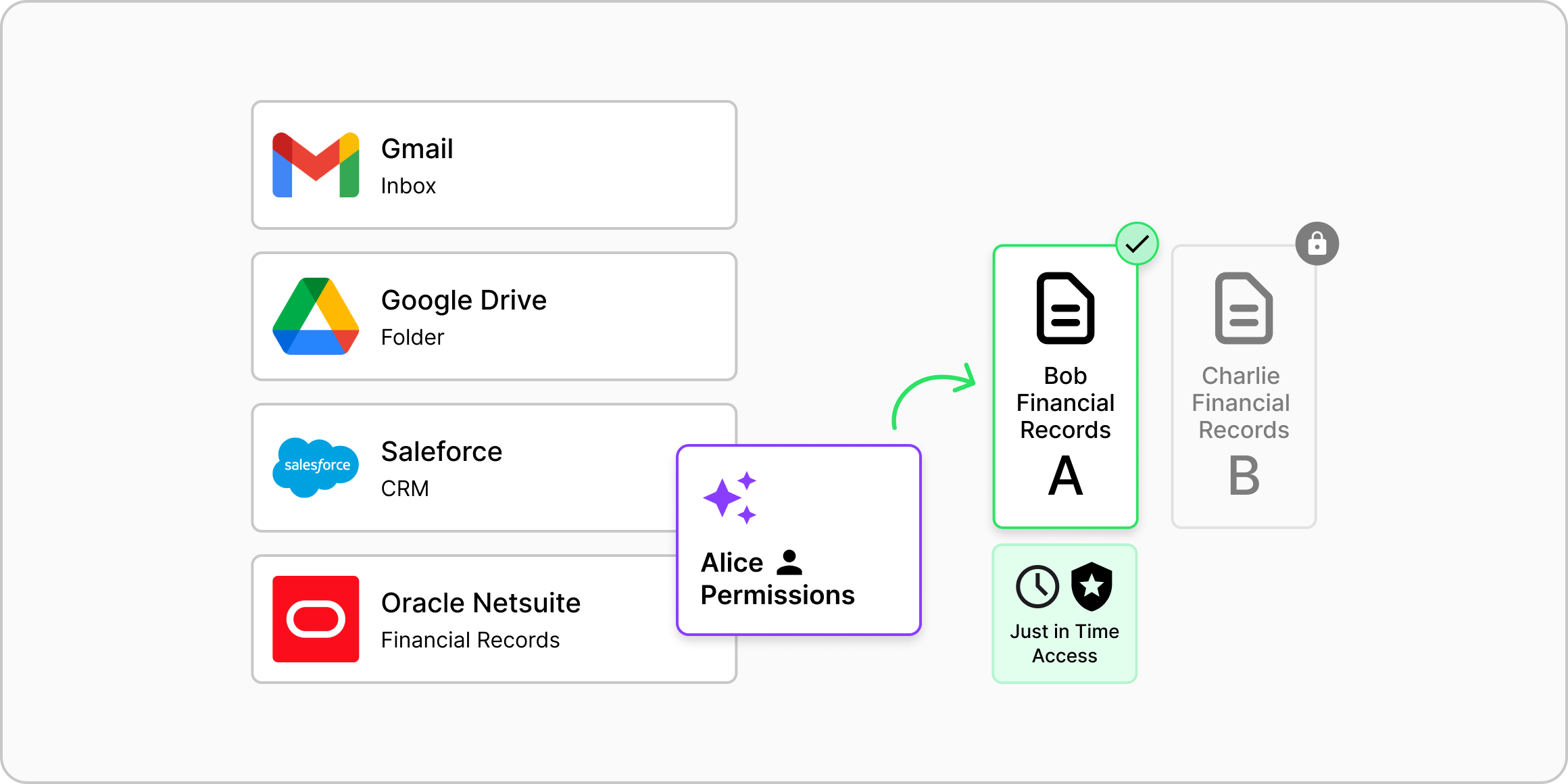
The Control Pillar sets defined operational boundaries for agent resource access and actions.
Controlled autonomy requires that agents possess only the permissions necessary to complete their specific tasks - no more, no less. This principle manifests in several architectural requirements.
Rather than providing agents with persistent credentials or broad permissions, Lemma implements dynamic access grants. An agent receives only the permissions required for each specific task, and those permissions expire when the task completes. This dramatically reduces the attack surface while maintaining operational flexibility.
Workflows often mix identities: an agent might access data on behalf of a user (adhering to that person's permissions) while executing other steps as a system identity. Lemma integrates directly with existing identity providers, maintaining a single source of truth while allowing dynamic identity injection at the workflow level. Decades of IAM best practices remain intact even as autonomous systems enter the picture.
Control means explicitly defining which tools and data sources an agent can invoke. Rather than allowing agents to discover and access any available resource, Lemma implements strict allow-lists that confine agent behavior within predetermined boundaries. An invoice-processing agent cannot suddenly access HR systems simply because a path exists.
Data encryption and compliance frameworks (SOC 2, HIPAA, GDPR) form the baseline. Secure connections to MCP servers, applications, and enterprise systems are established and managed through a dedicated infrastructure layer - not configured at the workflow level where they become fragmented and difficult to audit.
Control isn't about limiting AI capability. It's about ensuring that capability operates within boundaries that the business defines and trusts.
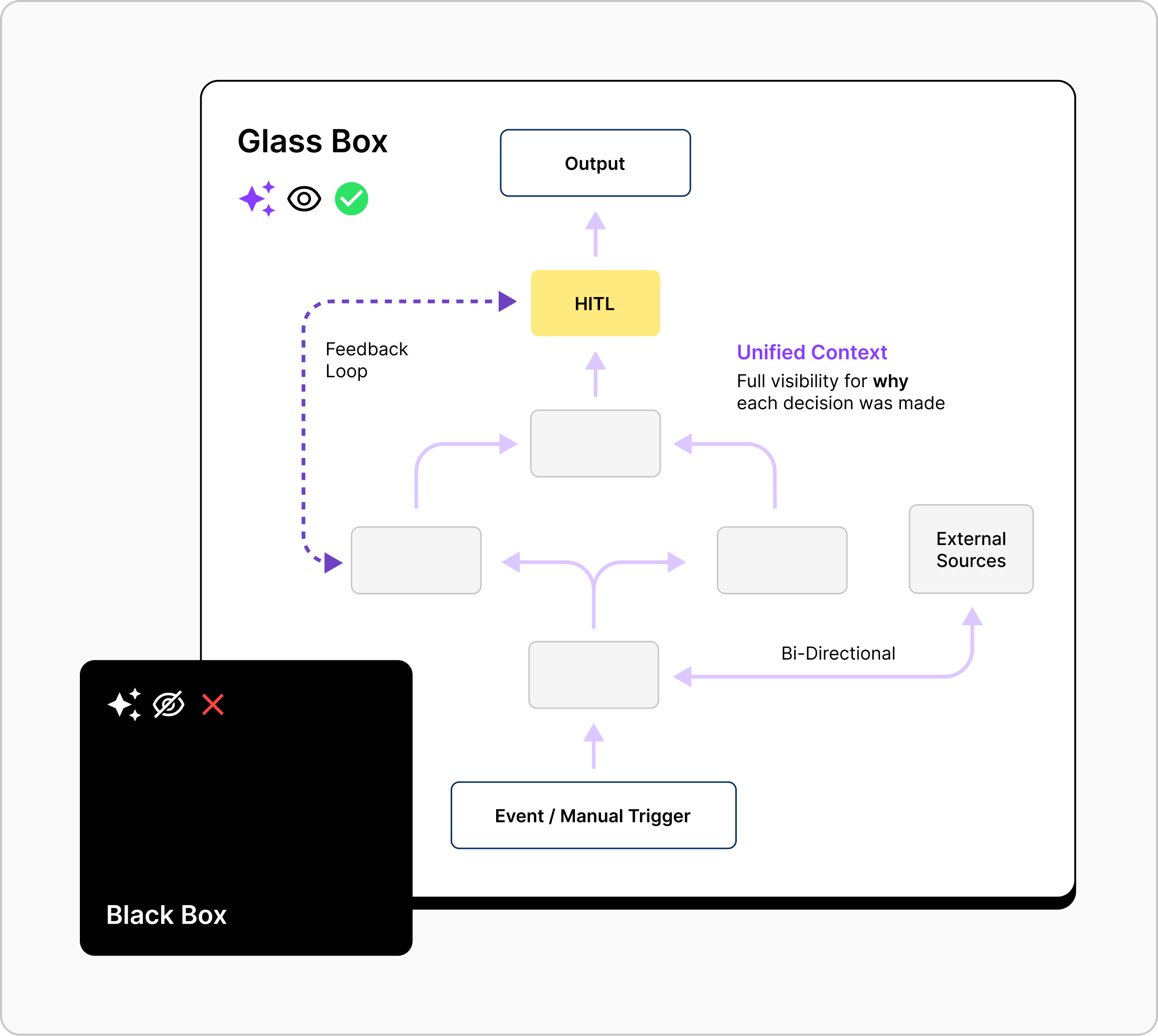
The Governance Pillar enables complete observability and traceability onto agent actions and decision-making.
If Control defines boundaries, Governance ensures those boundaries are maintained, and provides the transparency to verify it. AI systems operating in critical environments must function as glass boxes, not black boxes.
Every AI-to-system interaction is logged with full context: which data was accessed, which systems were involved, which prompts were provided, and which decisions were made. You can observe the exact state of any workflow, the data context, and the logic path that led to each decision. This transparency serves security teams, engineers, compliance officers, and business stakeholders alike.
When regulators or auditors ask how a decision was made, the answer must be complete and defensible. Lemma captures the entire decision chain - not just the outcome, but the reasoning process, the data inputs, and the human touchpoints along the way. This traceability is essential for regulated industries where AI decisions carry legal and compliance implications.
Outcome control transforms dynamic agentic behavior into deterministic, auditable processes. Human-in-the-Loop (HITL) states pause workflows at critical decision points, surface relevant context to domain experts, and incorporate feedback or approval before proceeding. Lemma implements HITL as a core architectural component, not an afterthought, providing complete control over AI-driven results. This matters in processes like underwriting approvals or financial system updates, where human judgment remains essential.
Governance ensures that controlled autonomy remains controlled. The agent acts independently within its boundaries, but every action is observable, traceable, and subject to human oversight at critical junctures.
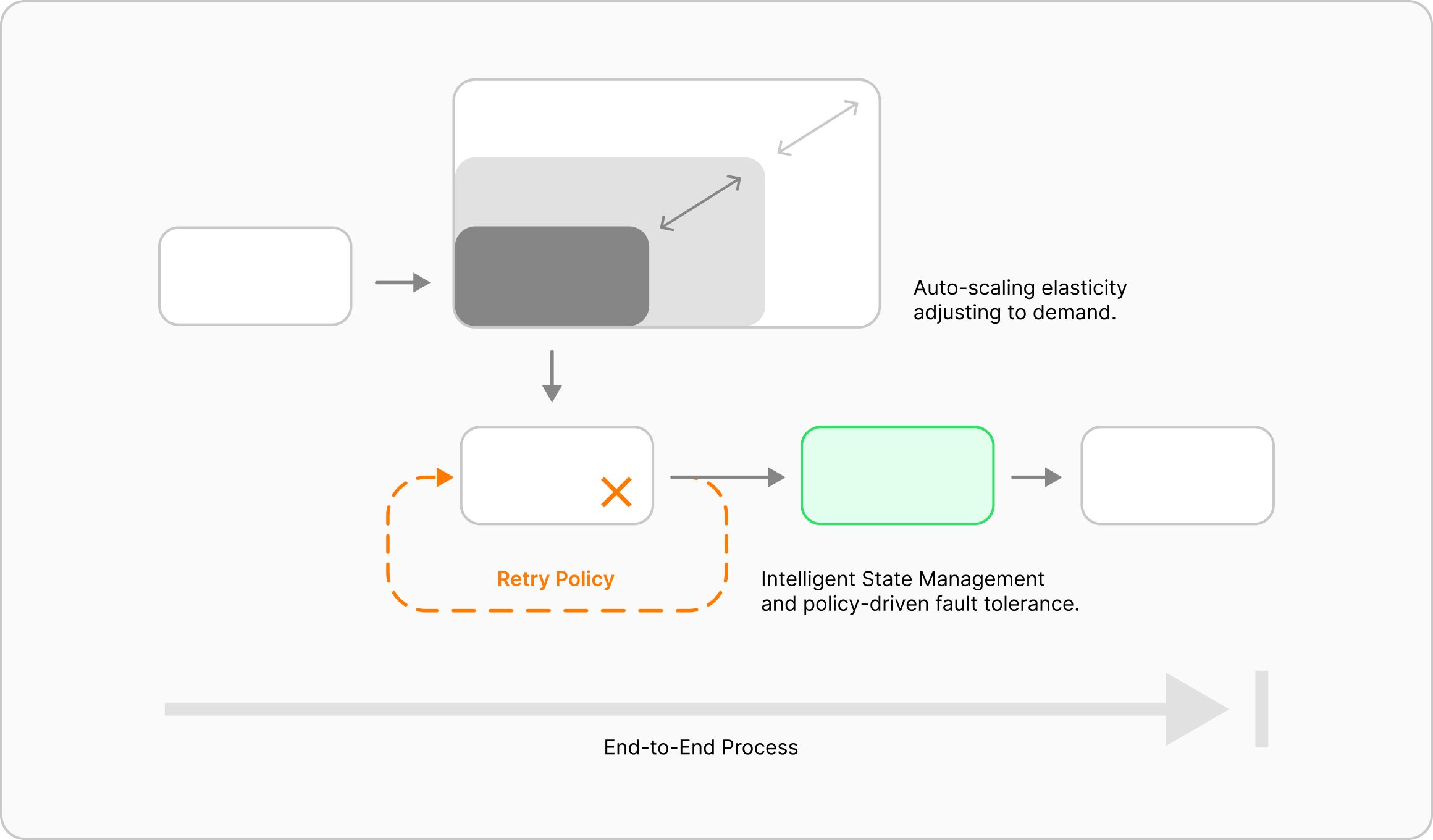
The Reliability Pillar ensures consistent and accurate process completeness. Even for external faults (e.g., outage, connection issue) the process will resume at its current step.
For mission-critical automation, reliability means workflows continue to operate correctly even when individual components fail, and scale gracefully as demand grows.
When a workflow fails mid-execution, the system doesn't simply retry the entire process. Consider a payment workflow that fails after deducting funds but before sending confirmation. Naive retry logic could deduct funds twice. Lemma's state tracking ensures each action executes exactly once, preventing the cascading errors that occur when autonomous systems interact with financial or operational systems. This precision protects data integrity and prevents security incidents caused by duplicate or orphaned transactions.
Transient failures (e.g. temporary network issues, service disruptions, rate limits) shouldn't cascade into workflow failures. Underlying retry policies automatically handle these situations with appropriate backoff strategies. Clear error messages, detailed execution traces, and the ability to replay failed workflows enable rapid incident response.
Workflow infrastructure designed for processing ten invoices faces different requirements when handling thousands. Lemma's architecture includes built-in elasticity and auto-scaling for both compute and data layers, tailoring resource allocation to tenant needs. Production-ready infrastructure scales horizontally without requiring workflow redesign or manual intervention - maintaining security and governance guarantees at every scale.
Reliability ensures that controlled autonomy delivers consistent results. An agent that works correctly once must work correctly every time, regardless of load or transient failures.
These three pillars of Control, Governance, and Reliability form the technical foundation for production-grade AI. Together, they enable controlled autonomy: the ability for AI agents to reason, plan, and execute within boundaries that the business defines and trusts.
The question for enterprise AI leaders isn't whether to build solutions with these pillars in mind, but whether to dedicate engineering resources to maintaining such infrastructure. Custom solutions require teams to focus on distributed systems problems rather than business outcomes, on debugging infrastructure instead of shipping new capabilities.
Lemma's protocol-level architecture enables composability at enterprise scale. Every workflow component can become a reusable asset shared between teams and reconfigured for cross-domain use cases. This creates compounding value: teams leverage each other's work, accelerating time-to-value with each new workflow while maintaining the control, governance, and reliability standards required for production operations.
The technical foundation for enterprise AI must account for operational reality. Legacy systems don't communicate in standardized formats. API schemas change without warning. Network failures happen mid-transaction. Regulatory requirements evolve. Production environments are unpredictable - and AI systems operating within them demand infrastructure built to handle this complexity as a design principle.
If you're evaluating orchestration infrastructure for production-grade AI, we welcome the opportunity to discuss how Lemma addresses your specific requirements and demonstrate these architectural principles in action. Get in touch.