New in Facts, Rules, Runtime: How a Harness Learns from Engineering Judgment.Facts, Rules, Runtime: Post 3 is live. Read the post

Jen Hilibrand - VP, Applied AI and Strategy at Thread AI
Chetan Chauhan - VP, International Business Development at Brightstar
August 5, 2026
We explore how Brightstar Lottery is using AI to enhance its business development function by scanning all relevant global procurement portals regularly to create a reliable pipeline of qualified opportunities.
Multi-Million
Value of qualified opportunities surfaced early via continuous, AI-powered global monitoring
Global
Reach via multilingual procurement intelligence
~2 Days
From zero to working prototype, built by a non-technical business user
Winning contracts in regulated markets is not just a matter of capability, but also visibility. For leading lottery technology provider and operator Brightstar, operating across six continents, business is won via highly competitive formal procurement processes. These processes are administered by a diverse set of governments, regulators and private companies in dozens of languages, published across fragmented portals and registries that are ever-changing.
Brightstar's business development teams are highly skilled, and the company continues to invest in how it turns market signals into action. As the volume and geographic spread of relevant procurement activity accelerated, Brightstar took a proactive step: using AI to extend its day-to-day coverage, reduce manual monitoring overhead, and strengthen its "peripheral vision" across regions, languages, and portals, so teams can see earlier, qualify faster, and focus human effort where it matters most.
In a highly competitive industry where contracts operate on multi-year or decade-long cycles, maintaining continuous awareness of new opportunities is critical to Brightstar's growth strategy. Yet the formal processes through which new opportunities are awarded are notoriously difficult to monitor efficiently at scale, especially across jurisdictions, languages, and constantly changing publishing practices.
Each entity operates its own procurement portals, with its own schema, language, publication cadence, and formatting conventions. Some notices appear briefly before deadlines lapse; others are buried in dense technical specifications that require domain context to recognize as relevant. The result is a monitoring problem that rewards automation: high frequency, high variance, and high cost to handle manually.
In this sector, early signal is valuable. A newly published opportunity can represent significant revenue, years of recurring engagement, and a strategic foothold in a new region. Systematic, always-on visibility at the top of the funnel helps Brightstar act with more lead time and allocate resources with greater precision downstream.
At the same time, the business development team needed more than a raw feed of notices. They needed decision-ready context: relevancy scoring, competitive framing, and supporting documentation, packaged in a way that streamlines triage, enables fast human review, and preserves accountability in how opportunities are prioritized.
Thread AI and Brightstar's business development team partnered to design and deploy an intelligent procurement monitoring workflow powered by Thread AI's Lemma platform. The result is a system that operates continuously in the background, surfacing qualified opportunities with full context and routing them through a structured human review process before distribution to the right commercial teams.
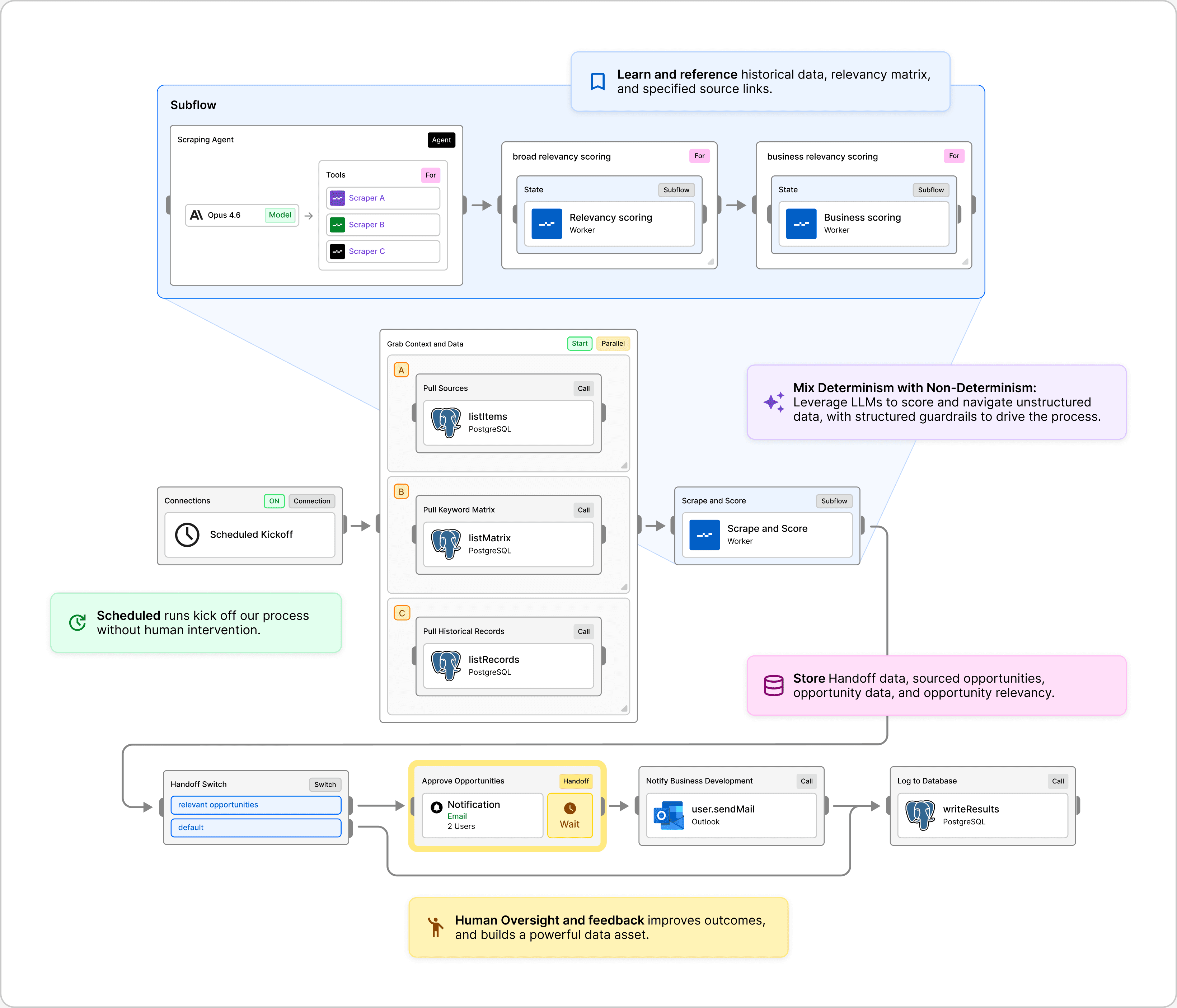
The workflow operates in three coordinated stages:
The workflow runs on a recurring schedule with no human intervention required. At each execution, it pulls the latest sources, relevancy scoring criteria, and historical records from a central data store, ensuring every run reflects the most current strategic priorities and past opportunity data.
A Lemma Worker agentically navigates procurement portals across regions, extracting and parsing content. Each identified opportunity is scored against a dynamic relevancy matrix that assesses commercial relevancy and alignment, processing a mix of structured and unstructured data.
When a scored opportunity clears the relevancy threshold, the workflow generates an AI summary with source attribution and relevancy rationale, then routes it to designated reviewers for approval. Approved opportunities are distributed to targeted business development teams via a formatted opportunity digest, with full supporting documentation included.
This Lemma Worker completes a mix of deterministic and non-deterministic elements to execute on a complex vision. This involves a mix of actions like agentic site navigation (where the Worker reads and interprets content with human-like judgment) and unstructured data extraction that can vary in shape, language, and context to adhere to a specific, predictable schema. This ensures reliability and control where needed, while leveraging a wide array of dynamic information sources.
Each opportunity is evaluated against a relevancy matrix stored in Brightstar’s central data store. The matrix can be updated by the team as priorities shift without requiring any changes to the underlying workflow, as the Lemma Worker pulls the most up-to-date information across disparate systems. This architecture ensures the system’s outputs remain aligned with commercial strategy over time, and that every scored result can be traced back to the specific criteria that drove it.
The human review step is not merely a quality gate; it is a mechanism for continuously improving the system’s outputs. Reviewer decisions feed back into the data layer, refining the relevancy model over time and building an institutional record of what the team considers genuinely actionable. The longer the system runs, the more accurate its signal becomes. The Worker runs every day in the background, while human oversight and feedback improve outcomes and build a powerful data asset.
By deploying this Lemma-powered workflow, Brightstar unlocked two distinct levels of operational value:
First, Brightstar established consistent, always-on visibility across its global footprint. Business development teams are now supported by automated, multi-regional monitoring that scans relevant portals and surfaces qualified signals across regions, languages, and formats, expanding peripheral vision of opportunities and ensuring the right teams see the right opportunities early enough to act deliberately.
Second, the workflow improves day-to-day operating rhythm. Rather than spending time collecting and translating raw links, reviewers receive a structured digest: a relevancy score, an AI-generated summary, source attribution, and supporting context. This makes qualification faster and more consistent, so human effort is concentrated on judgment calls and pursuit strategy, not repetitive monitoring work.
This deployment illustrates a broader principle that shapes how Thread AI thinks about workflow automation: the most powerful applications occur when intelligence gathering is embedded as the first step in a larger orchestration, not treated as the end-product.
With Lemma, the retrieval, scoring, and summarization of procurement data becomes the foundation for downstream actions like decision routing, CRM updates, proposal initiation, competitive tracking, and pipeline reporting. We are actively moving toward a model where the system not only identifies opportunities but actively orchestrates the response to them, compressing the time between signal and action across the entire business development cycle.
In the broader regulated-industry landscape, this approach opens the door to automating complex, multi-stage workflows, market entry analysis, compliance monitoring, competitive intelligence, and strategic account planning where structured intelligence is merely the first step toward a tangible commercial outcome.
Brightstar's use-case demonstrates how agentic AI can be applied as "invisible infrastructure" in highly regulated, geographically distributed markets. It represents a shift in how business development operates: from periodic, manual scanning to proactive, systematic awareness of the global opportunity landscape, built to improve operational efficiency while extending reach across languages and regions.
By deploying agentic AI to augment and extend human capability, development teams are no longer limited by geography, language, or bandwidth. They are equipped to execute on the contracts that power their growth.
Start building your procurement intelligence workflow and gain immediate value by leveraging Thread AI's pre-built critical patterns.
Contact our team to learn more and gain a similar competitive advantage.